
 531-355-1234
Sounds are all around us. We hear when these sounds pass through the outer, middle, and inner parts of our ears—sending thousands of tiny vibrations up to our brain for interpretation.
First, sound travels through the outer ear canal and makes the eardrum move. When the eardrum moves, the three middle ear bones vibrate.
This vibration creates movement of fluid in the inner ear, also known as the cochlea. The fluid movement causes sensory receptors in the coiled-shaped cochlea to send a signal along the auditory nerve to the brain, and this is how we hear.
The cochlear implant is an electronic device that can provide a sense of sound to a person who is deaf or profoundly hard-of-hearing. This type of device is very different from a hearing aid, which serves only to amplify sound. A cochlear implant transforms sounds into electrical signals and transmits these signals directly to the auditory nerve of the inner ear, bypassing any damaged structures in the ear that are impeding normal hearing.
Parts of a Cochlear Implant
All cochlear implants, regardless of manufacturer, consist of two general components:
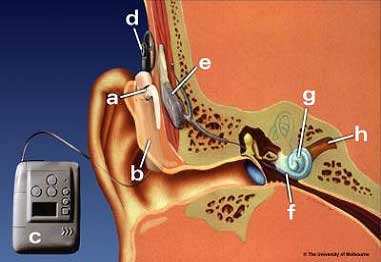
- Internal device (e): The internal portion of the implant consists of two parts: the receiver/stimulator and the intracochlear electrode array.
- External hardware (a-d): The external portion consists of three parts: a microphone, a speech processor, and a transmitting coil.
How a Cochlear Implant Works
- Sound is picked up by the microphone (a), where it is sent down a cord (b) to the speech processor (c).
- The speech processor filters the incoming acoustic signal into separate frequency bands, and then converts this information into digital form.
- The digitized signal is sent back up the cord to the transmitting coil (d), which is held in place by a magnet.
- The coil transmits the digitized information across the skin to the internal receiver/stimulator (e).
- The internal receiver/stimulator decodes the incoming signal and sends information in each frequency band to a different electrode within the cochlea (f). (The internal receiver/stimulator also contains a magnet to which the external coil sticks.)
- High-frequency information is sent to electrodes in the basal end of the cochlea (f), and low-frequency information is sent to electrodes in the apical end of the cochlea (g).
- Electrical stimulation from the intracochlear electrodes takes the place of damaged cochlear structures or hair cell - nerve synapses.
- The auditory nerve (h) picks up the electrical signals from the electrodes and relays that information to the brain where it is interpreted as sound.
In this video, Jeffrey Simmons, Au.D., CCC-A, a Cochlear Implant Clinician at Boys Town National Research Hospital explains in detail the parts of a cochlear implant and how a cochlear implant works.
You may also like these
See All